AI Adoption, Workplace Productivity, and the Next Stage of Responsible AI
Artificial Intelligence is no longer a futuristic concept—it has quietly become a part of everyday work. Across industries, professionals are integrating AI tools into their daily routines to improve productivity, automate repetitive tasks, and accelerate decision-making.
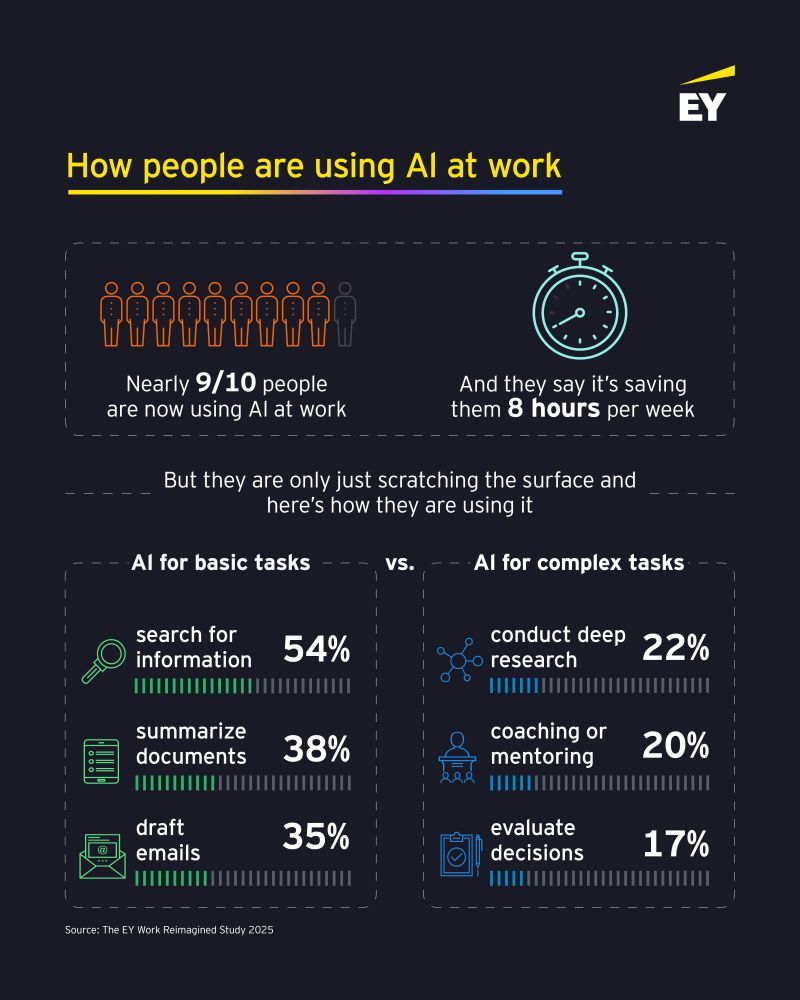
According to the EY Work Reimagined Study 2025, nearly 9 out of 10 people are already using AI at work, and many report that it saves them around 8 hours every week. That is essentially an extra working day gained through automation and assistance.
However, despite this rapid adoption, the way most professionals currently use AI reveals an interesting pattern: AI is primarily used for basic tasks rather than complex decision-making or strategic work.
This suggests that organizations are still only scratching the surface of AI’s true potential.
AI Is Mostly Used for Basic Productivity Tasks
For many employees, AI has become a powerful assistant that helps complete routine work faster. The EY study highlights that most usage revolves around information processing and communication.
The most common use cases include:
- Searching for information (54%)
- Employees use AI tools to quickly gather insights, explanations, or references instead of manually browsing multiple websites.
- Summarizing documents (38%)
- Long reports, research papers, or meeting notes can now be condensed into key points within seconds.
- Drafting emails (35%)
- AI helps professionals write structured emails, responses, or communication drafts more efficiently.
These activities demonstrate how AI is acting as a productivity multiplier, reducing time spent on repetitive tasks and allowing professionals to focus on higher-value work.
AI for Complex Work Is Still Limited
While AI is widely used for simple productivity improvements, its adoption for more advanced or strategic tasks remains relatively low.
The EY study shows that fewer professionals currently rely on AI for complex responsibilities such as:
- Conducting deep research (22%)
- Coaching or mentoring (20%)
- Evaluating decisions (17%)
This gap indicates that many organizations are still in the early stages of AI maturity. Employees may trust AI to help write emails or summarize documents, but they remain cautious when using it for strategic thinking, leadership decisions, or analytical work.
This hesitation is understandable. Complex use cases require stronger trust, governance frameworks, and accountability mechanisms.
Why Organizations Are Only Scratching the Surface
There are several reasons why AI adoption remains concentrated around basic tasks:
1. Lack of AI Governance Frameworks
Many organizations have not yet defined policies around how AI should be used responsibly, especially for decision-making.
2. Limited AI Literacy
Employees often understand how to prompt AI for simple tasks but may not know how to use it for deeper analysis or innovation.
3. Trust and Risk Concerns
Concerns around accuracy, bias, data privacy, and compliance make organizations cautious about relying on AI for critical decisions.
4. Integration Challenges
AI tools are frequently used as standalone assistants rather than being deeply integrated into enterprise workflows.
The Next Phase: From Productivity Tool to Strategic Partner
As organizations mature in their AI adoption, the role of AI will evolve from being a simple assistant to becoming a strategic collaborator.
Future use cases will include:
- Intelligent decision support systems
- AI-driven research and analysis
- Personalized employee training and mentoring
- Autonomous workflow optimization
- Strategic forecasting and risk analysis
However, this shift will only be possible if organizations develop strong AI governance practices that ensure responsible, transparent, and trustworthy use of AI.
The Role of AI Governance
As AI moves from assisting tasks to influencing decisions, governance becomes essential.
Organizations must establish frameworks that address:
- Transparency in AI-driven outputs
- Data privacy and security
- Bias detection and fairness
- Accountability for AI-assisted decisions
- Compliance with emerging global regulations
Without these safeguards, the risks associated with AI could outweigh its benefits.
This is why AI governance is becoming one of the most critical leadership challenges of the next decade.
Final Thoughts
The EY report clearly shows that AI is already transforming the workplace. Employees are saving time, improving productivity, and automating everyday tasks.
But the bigger opportunity still lies ahead.
Organizations that move beyond basic AI usage and invest in AI literacy, responsible governance, and strategic integration will unlock far greater value.
AI is not just a tool for writing emails or summarizing reports—it has the potential to reshape how organizations think, decide, and innovate.
The question is no longer whether AI will change work, but how responsibly and effectively we choose to use it.